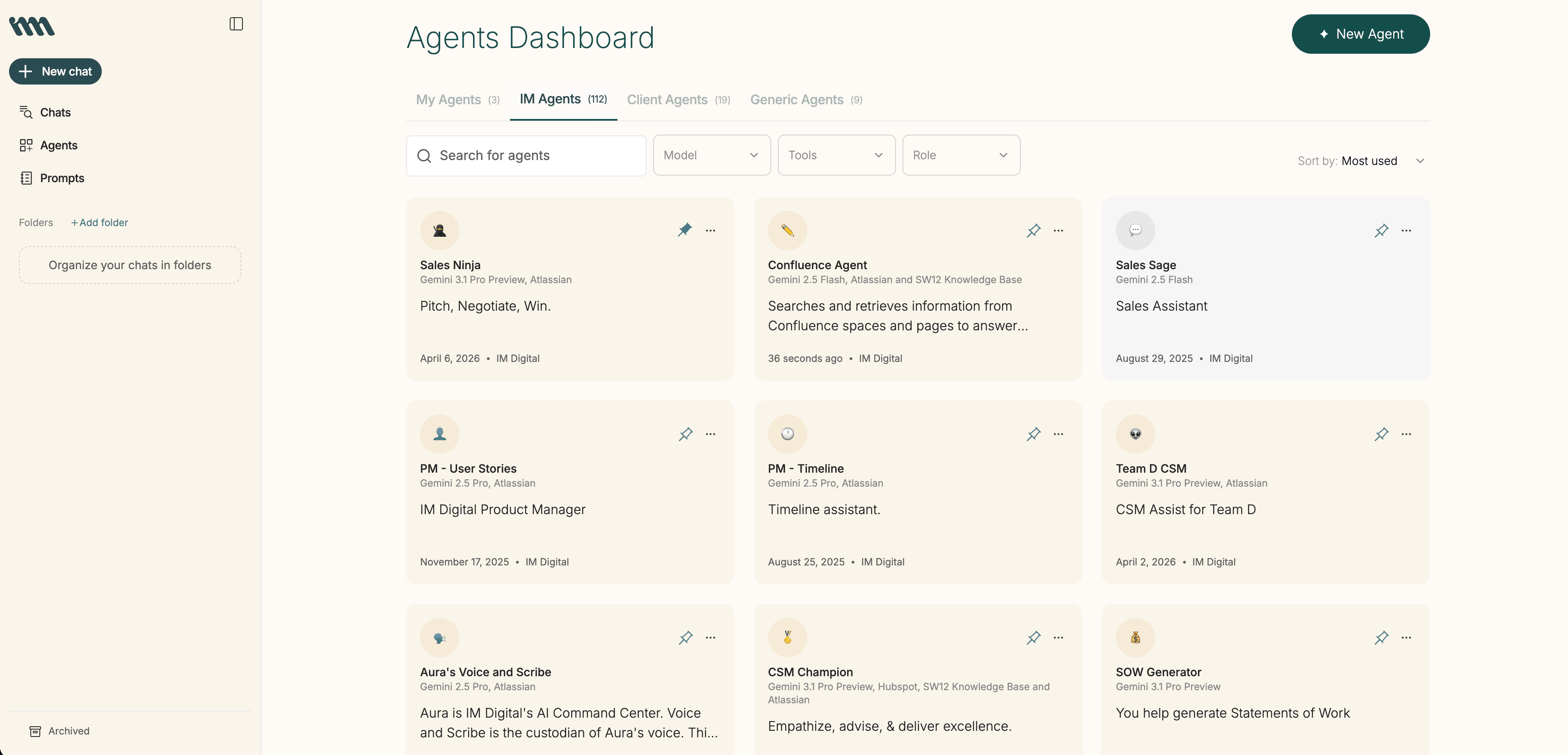
Late 2024 we started building an internal AI platform. The commercial tools weren't quite where we needed them, so we built what we needed. Now, about eighteen months later, the market has largely caught up and we're asking ourselves whether keeping our custom-built approach is still the right answer.
Our AI Command Center: The "Why" Behind the Build
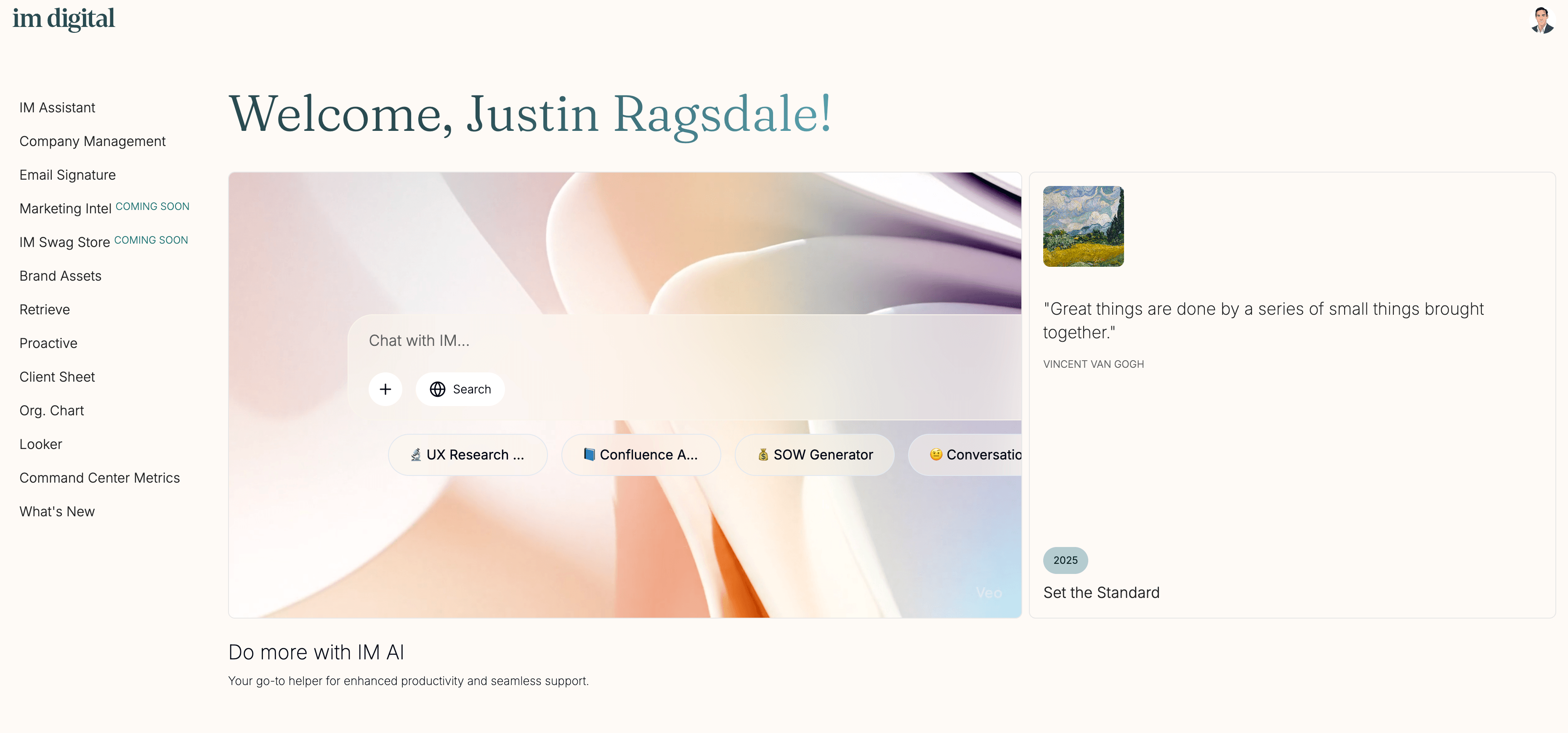
So what did we build? An internal platform we came to refer to as our AI Command Center. The core idea was simple: let anyone with domain knowledge create an AI agent without writing code. You write a system instruction (English instructions describing what your agent should do), pick the integrations it can use from a list, and you're done. Jira, Confluence, Google Analytics, and more, turned on with a checkbox.
Conversations are saved centrally. You can share them with colleagues. The platform hooks up to multiple LLMs (not locked into a single provider's roadmap). Role-based access control means you can create an agent for yourself, share it with your team, or keep it locked down. We added simple RAG support for connecting agents to your own documents.
A lot of these features are now standard in commercial platforms, but we had the basics working back in late 2024. It was educational to build them as it forced us to get deep into the code to work out what was possible.
Organic Evolution: The Sales Coach Case Study
The most interesting thing about building your own tool is that you add what you need, when you need it. You're not waiting on a product roadmap from a 3rd party vendor. (The counter is a 3rd party product may deliver you features that you did not even realize you wanted!)
Our clearest example is something we call our Sales Coach. We built it originally to review sales pitches, giving staff feedback when pitching to clients to ensure consistent, on-brand messaging. Useful, but contained. Then something interesting happened: people started finding other uses for it.

It evolved into a tool for reviewing client conversations, coaching staff, and capturing institutional knowledge that had previously lived in people's heads. We added a collection of "gold class" reference documents (our strongest proposals, our sharpest thinking from past engagements), helping the agent to produce higher class proposals from scratch. A human takes that draft and finishes it.
That shift from "pitch reviewer" to something much broader because the platform bent to how people actually worked. By building a platform for our subject matter experts to create agents on, the engineering team did not have to be domain experts. Engineering got hands on with the AI APIs, the sales team wrote and tuned the system instructions themselves.
A Key Finding: Full-Document Context vs. RAG
Here's a finding that surprised us, and one I think gets underplayed: with modern models more context in prompts generally produces better results, even when conventional wisdom says to keep prompts short and focused.
We actually started inserting complete reference documents into prompts. It burns tokens, but it was quick to get going. Later we added RAG support (retrieval-augmented generation), where you split documents into chunks and retrieve only the relevant pieces at query time. The theory is clean: don't overwhelm the model, give it only what it needs. The practice is messier: it relies on search finding the right content, and many RAG systems break documents into smaller chunks losing the context of passages of retrieved text.
So why is RAG still around? In the early days, long prompts were first not even supported. Then once supported, they often confused the models. Modern models have improved significantly, changing the tipping point of how much text is worth injecting into a model's prompt. RAG has not gone away, but if you can defer its use you can actually improve response quality.
The R&D Advantage: Our Strategy for Staying Internal
We're a consulting business, not a product company. That matters.
At various points we talked about whether Command Center could become a product. Each time, we watched large players move in that direction and concluded: that's not our game. We're not competing with Microsoft or Google on platform infrastructure.
What we got instead was eighteen months of hands-on experience with enterprise AI under real working conditions, a platform shaped by our actual needs, and a set of learnings we couldn't have acquired any other way. The Sales Coach grew the way it did because we owned the platform. The RAG findings came from real usage, not a proof of concept. Building internally, when you're not a product company, is a form of R&D. The output is the knowledge.
Reconsidering Our Build: The Maturation of Enterprise AI
About three months ago we did a formal evaluation of Gemini Enterprise and concluded it still wasn't quite there. It had gaps we'd already solved ourselves, and migrating would have meant losing capability.
We've just done another look after the recent Google Next conference, and things have shifted. It feels like it's crossed a threshold. The enterprise alignment is stronger. The integration story is better. And maintaining a custom platform has a cost that compounds quietly over time in ways that are easy to underestimate when you're building but harder to ignore once you're running.
So we're starting a serious evaluation with migration in mind. Not abandoning what we built (the lessons come with us), but asking honestly whether the custom layer is still pulling its weight.
Our Path Forwards: Gemini Enterprise
We are currently moving some of our internal use cases over to Gemini Enterprise and things are going well. The Gemini models are improving, the authentication model is solid, product gaps are continuing to be filled.
I'll be sharing more about our journey over the coming weeks: what Gemini Enterprise can do now that it couldn't six months ago, where the gaps still are, and practical ways AI can help staff be more effective at their jobs in little and big ways. We have always put a focus on helping our staff do a better job for our clients, driven by staff requests for tools.
Today, should you build your own AI platform? In late 2024, building made sense for us. As we approach mid-2026, I think the answer is no. Pick a platform, put your focus into what agents can do for your organization. The platforms available today are not perfect, but they are improving. What if you pick the wrong platform? I think the answer is the same as it has always been with vendors: as much as possible adopt open standards so moving is easier. But get moving, because the rest of the world is.